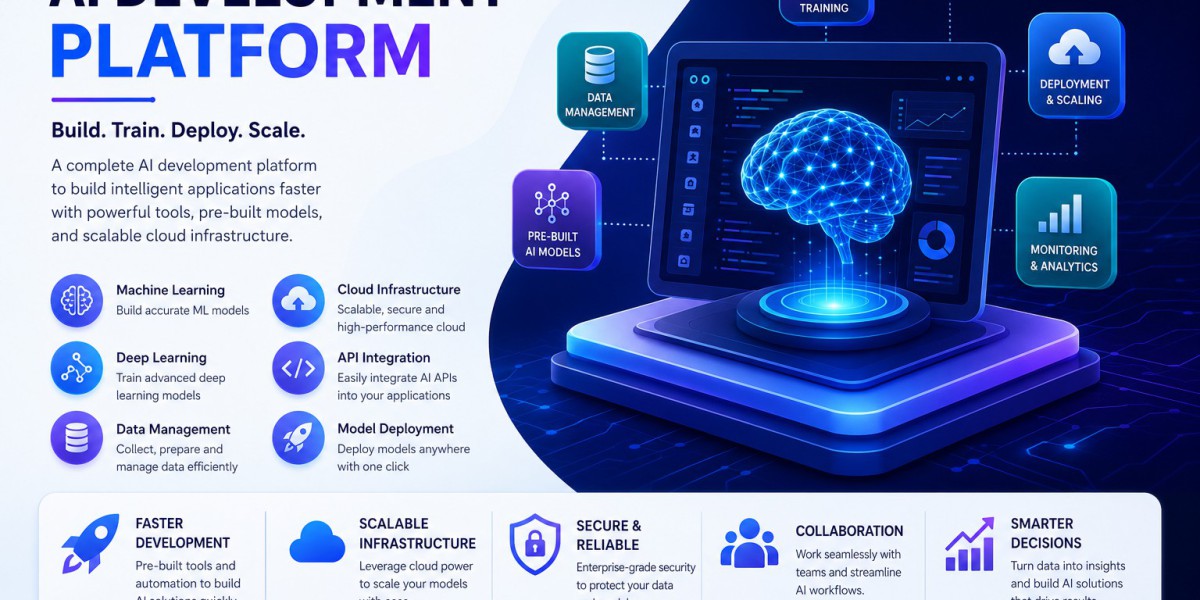

AI Development Platform: A Complete Guide to Building Smarter AI Solutions
Artificial Intelligence (AI) is transforming industries by automating processes, improving decision-making, and delivering personalized user experiences. Whether it's healthcare, finance, e-commerce, education, or manufacturing, businesses are investing heavily in AI-powered solutions to stay competitive. However, building intelligent applications requires more than just algorithms—it demands a reliable AI Development Platform.
An AI development platform provides developers, businesses, and data scientists with the tools needed to build, train, deploy, and manage artificial intelligence models efficiently. From machine learning and deep learning to natural language processing (NLP) and computer vision, these platforms simplify the entire AI development lifecycle.
In this guide, we'll explore what an AI development platform is, its key features, benefits, popular platforms, and how to choose the right one for your business.
What Is an AI Development Platform?
An AI Development Platform is a software environment that enables developers to create, train, test, deploy, and monitor AI applications. It combines machine learning frameworks, cloud computing, data management tools, APIs, and deployment services into a single ecosystem.
Instead of building everything from scratch, developers can use pre-built models, automation tools, and scalable infrastructure to accelerate AI development.
These platforms support technologies such as:
- Machine Learning (ML)
- Deep Learning (DL)
- Natural Language Processing (NLP)
- Computer Vision
- Generative AI
- Predictive Analytics
- Speech Recognition
By providing ready-to-use tools, AI development platforms reduce development time and improve model accuracy.
Why Businesses Need an AI Development Platform
Artificial intelligence projects often involve handling large datasets, training complex models, and deploying applications across multiple environments. An AI development platform simplifies these tasks while improving efficiency and scalability.
Some key reasons businesses adopt AI development platforms include:
- Faster application development
- Improved productivity
- Lower development costs
- Better collaboration among teams
- Easy model deployment
- Scalable cloud infrastructure
- Continuous monitoring and optimization
Whether you're a startup or a large enterprise, an AI platform helps turn ideas into intelligent applications quickly and efficiently.
Key Features of an AI Development Platform
A modern AI development platform comes equipped with several essential features that streamline the AI lifecycle.1. Machine Learning Tools
Most platforms include built-in machine learning frameworks that allow developers to build predictive models using structured and unstructured data.
Benefits include:
- Automated model training
- Feature engineering
- Hyperparameter tuning
- Performance evaluation
2. Data Management
AI models rely on high-quality data. AI platforms provide tools to collect, clean, label, and organize datasets efficiently.
Good data management improves model accuracy and reduces development time.
3. Cloud-Based Infrastructure
Cloud integration allows developers to train AI models without investing in expensive hardware.
Advantages include:
- Flexible computing power
- Automatic scaling
- Secure storage
- Faster deployment
4. Pre-Trained AI Models
Many AI development platforms offer ready-made models for common tasks such as:
- Image recognition
- Language translation
- Sentiment analysis
- Text generation
- Speech-to-text conversion
These models help developers launch projects much faster.
5. API Integration
Modern platforms provide APIs that allow businesses to integrate AI capabilities into websites, mobile apps, CRMs, and enterprise software without extensive coding.
6. Model Deployment
Once an AI model is trained, it must be deployed into production. AI platforms simplify deployment through automation and containerized environments.
Developers can deploy models on:
- Cloud servers
- Mobile applications
- Web applications
- IoT devices
- Edge computing systems
7. Monitoring and Maintenance
AI models require continuous monitoring to ensure accuracy and performance over time.
Platforms provide dashboards for:
- Performance tracking
- Error detection
- Model updates
- Usage analytics
Benefits of Using an AI Development Platform
Organizations adopting AI platforms experience numerous advantages.
Faster Development
Pre-built components significantly reduce coding time.
Improved Accuracy
Automated optimization tools improve machine learning performance.
Cost Efficiency
Cloud-based services eliminate expensive hardware investments.
Better Collaboration
Developers, data scientists, and business teams can work together within a unified environment.
Scalability
Businesses can scale AI projects as demand grows without rebuilding infrastructure.
Popular AI Development Platforms
Several companies offer industry-leading AI development platforms.
Some of the most widely used include:
- Google Vertex AI
- Microsoft Azure AI
- Amazon SageMaker
- IBM Watson
- OpenAI API
- DataRobot
- H2O.ai
Each platform offers unique capabilities depending on business requirements and technical expertise.
Industries Using AI Development Platforms
Artificial intelligence is no longer limited to technology companies. Many industries now rely on AI platforms to improve operations.
Healthcare
- Disease prediction
- Medical imaging
- Patient monitoring
- Drug discovery
Finance
- Fraud detection
- Credit scoring
- Risk analysis
- Algorithmic trading
E-Commerce
- Product recommendations
- Customer support chatbots
- Inventory forecasting
- Personalized shopping experiences
Education
- Adaptive learning
- Automated grading
- Virtual tutors
- Student performance analytics
Manufacturing
- Predictive maintenance
- Quality inspection
- Supply chain optimization
- Robotics automation
How to Choose the Right AI Development Platform
Selecting the right platform depends on your organization's goals and technical requirements.
Consider the following factors:
- Ease of use
- Security features
- Cloud compatibility
- Pricing model
- Available AI tools
- Integration capabilities
- Scalability
- Community support
- Documentation
- Customer service
Choosing a platform that aligns with your long-term business strategy ensures a higher return on investment.
Future of AI Development Platforms
The future of AI development platforms looks promising as technology continues to evolve.
Emerging trends include:
- Generative AI integration
- No-code AI development
- AI-powered automation
- Explainable AI (XAI)
- Edge AI deployment
- Responsible AI governance
- Multi-cloud AI solutions
These innovations will make artificial intelligence more accessible to businesses of all sizes.
Conclusion
An AI Development Platform is the foundation for building intelligent, scalable, and efficient AI applications. By combining machine learning tools, cloud infrastructure, automation, and deployment capabilities into one environment, these platforms enable businesses to accelerate innovation while reducing development complexity.
Whether you're developing predictive analytics, AI chatbots, recommendation systems, or computer vision applications, the right AI development platform can significantly improve productivity, reduce costs, and help you deliver smarter solutions faster. As artificial intelligence continues to reshape industries, investing in a reliable AI development platform is no longer optional—it's a strategic decision for long-term growth and digital transformation.






